Understanding VCSEL vs EEL Tactical Laser Modules Technology
In recent years, many modern tactical laser aiming modules and IR illuminators have transitioned from traditional EEL (Edge-Emitting Laser) designs to the newer VCSEL (Vertical-Cavity Surface-Emitting Laser) technology.
While both are infrared laser emitters, their structure and performance differ significantly — and those differences matter for real-world tactical applications.
Structural and Functional Differences
| FEATURE | VCSEL | EEL |
|---|---|---|
| Emission Direction | Emits light vertically from the top surface | Emits light horizontally from the edge of the chip |
| Emitter Design | Often an array of multiple low-power emitters | Usually a single high-power emitter |
| Beam Profile | Very uniform, round, and clean beam with minimal distortion | Elliptical beam, often requiring more optics to shape |
| Thermal Efficiency | Runs cooler and more stable under long use | Generates more heat; may drift in alignment over time |
| Durability | Compact, shock-resistant design ideal for modern housings | Sensitive to vibration and heat buildup |
| Cost & Complexity | More complex to produce, but smaller and lighter modules | Simpler design, but less efficient and bulkier |
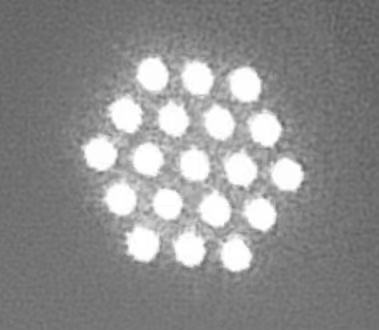
Performance in Tactical Use
VCSEL-based illuminators deliver cleaner, more disciplined beams, offering better control under night-vision systems.
Because each emitter runs at lower power, the overall beam has less scatter and bloom — meaning clearer target identification and more reliable co-alignment between the visible and IR channels.
EEL modules, while proven and still widely used, tend to produce hotter, more divergent beams, and can lose optical alignment under continuous use or heavy recoil.
In short:
VCSEL = precision and efficiency
EEL = simplicity and brute output
Our SomoGear PEQ-16 Aiming Laser now features an upgraded VCSEL infrared illuminator, delivering cleaner beam performance and improved night-vision compatibility.
Following its success, all upcoming SomoGear tactical laser modules will also transition to VCSEL technology for even greater efficiency and beam precision.
VCSEL Advantages
- Improved beam uniformity and directionality
- Higher efficiency and lower operating temperature
- Better optical stability and longer service life
- Compact form factor for multi-function modules
- Meets civilian power regulations more easily
VCSEL Limitations
- Slightly higher manufacturing cost
- More complex to calibrate during production
EEL Advantages
- Proven technology with simple design
- Strong peak output for legacy military systems
EEL Limitations
- Higher heat generation and alignment drift
- Beam shape often requires corrective optics
- Stricter FDA power classification in civilian use
FDA Compliance Statement
All laser products must comply with the U.S. FDA Center for Devices and Radiological Health (CDRH) laser safety standards (21 CFR 1040.10 & 1040.11).
VCSEL technology provides a structural advantage in this area — each emitter operates at a lower output level, allowing the combined system to deliver equivalent or superior performance while remaining within civilian-legal power limits.
Disclaimer:
All infrared aiming and illumination devices mentioned here are intended for lawful use only.
Power output and wavelength specifications must comply with applicable FDA and local jurisdiction regulations.
Users are responsible for operating these devices safely and in accordance with all relevant laws.
Summary
VCSEL modules represent the next generation of tactical laser technology — offering cleaner beams, cooler operation, and better regulatory compliance without sacrificing performance.
As manufacturers continue to refine VCSEL arrays, tactical users can expect smaller, smarter, and more reliable laser systems designed for both professional and civilian markets.
In short: VCSEL is not just a new component — it’s a smarter evolution of how tactical illumination is engineered.